
 895


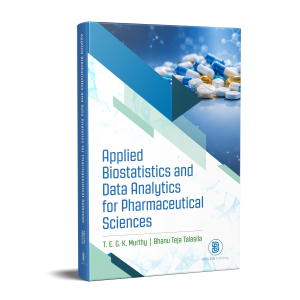
Applied Biostatistics and Data Analytics for Pharmaceutical Sciences is a comprehensive and practiceoriented textbook designed to provide a strong foundation in biostatistics and modern data analytics for students, teachers, researchers, and professionals in pharmaceutical and biomedical sciences. The book is prepared in accordance with the prescribed B.Pharm curriculum, with alignment to PCI academic requirements and the competency-based and technology-enabled learning objectives of NEP 2020. It presents statistical concepts in a simple, systematic, and application-oriented manner, with particular emphasis on their use in drug discovery and development, clinical research, pharmacokinetics,
pharmacodynamics, pharmaceutical quality control, stability studies, pharmacovigilance, and healthcare
research.
The book covers descriptive statistics, probability and statistical distributions, sampling and statistical inference, correlation and regression, and statistical analysis using Python. It integrates fundamental
statistical theory with pharmaceutical examples, numerical problems, tables, illustrations, datasets, and stepby- step Python programming approaches. Special emphasis is given to contemporary data analytics using Python libraries such as NumPy, Pandas, SciPy, Statsmodels, Scikit-learn, Matplotlib, and Plotly. The book is intended to help readers understand statistical principles, analyze pharmaceutical data, interpret results, and develop reproducible and data-driven approaches to pharmaceutical research and decision-making.
Features
Pharmaceutical and healthcare-oriented approach: Statistical concepts are explained using
practical examples from drug discovery and development, preclinical and clinical studies,
bioavailability and bioequivalence studies, pharmacokinetics, pharmacodynamics, quality control,
stability studies, pharmacovigilance, and public health research.
Curriculum-aligned and NEP 2020-oriented content: The book is prepared in accordance with the
prescribed B.Pharm curriculum, with alignment to PCI academic requirements and the competencybased
and technology-enabled learning objectives of NEP 2020. The content is structured to facilitate
conceptual understanding, practical application, analytical thinking, and data-driven learning in
pharmaceutical sciences.
Integration of biostatistics with Python-based data analytics: The book introduces practical
statistical analysis using Python and commonly used libraries including NumPy, Pandas, SciPy,
Statsmodels, Scikit-learn, Matplotlib, and Plotly. Step-by-step examples demonstrate correlation
analysis, linear regression, prediction, statistical modelling, data visualization, and model evaluation.
Useful for academic learning and pharmaceutical research: The book combines statistical theory,
worked examples, datasets, tables, graphical presentations, and executable Python approaches to
support students and researchers in understanding, analyzing, interpreting, and presenting
pharmaceutical and biomedical data. It also emphasizes reproducible, automated, and data-driven
statistical workflows.
• Descriptive Statistics
• Probability & Statistical Distributions in Healthcare
• Sampling & Statistical Inference
• Basics of Correlation & Regression
• Statistical Analysis Using Python